
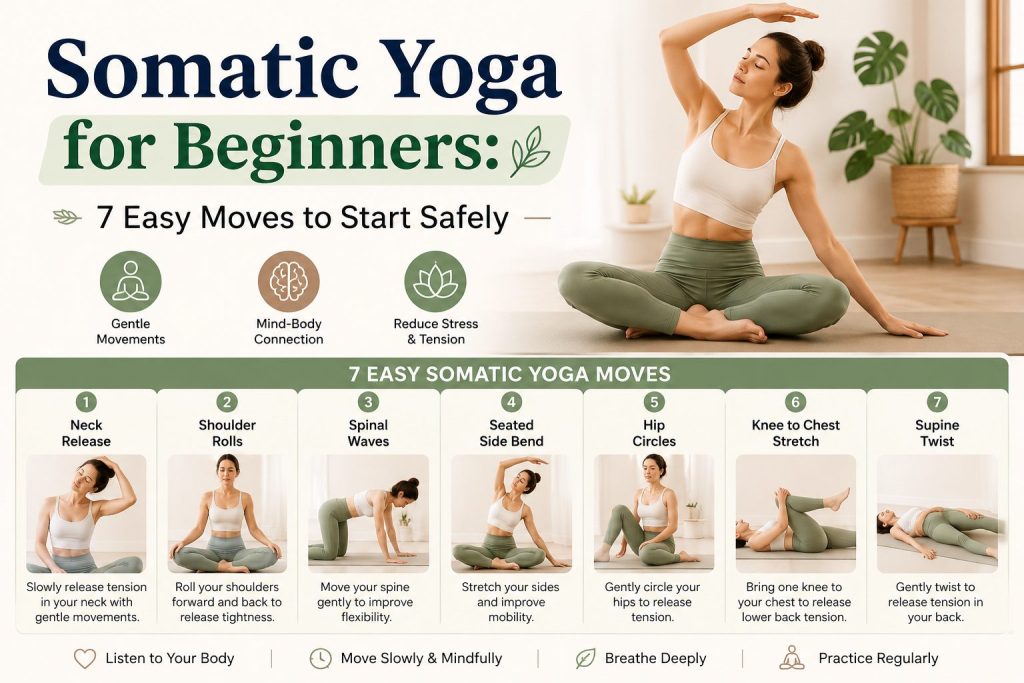
Somatic Yoga for Beginners is a gentle way to start moving your body with more awareness, less pressure, and better relaxation. Unlike intense workouts or advanced yoga classes, somatic yoga focuses on slow movement, comfortable breathing, and noticing how your body feels from the inside.
This beginner-friendly guide explains what somatic yoga is, how it works, possible benefits, safety tips, 7 easy movements, a simple 10-minute routine, common mistakes, and FAQs. It is designed for people who want a calm, low-pressure practice at home.
What Is Somatic Yoga for Beginners?
Somatic Yoga for Beginners is a slow and mindful movement practice that helps you pay attention to how your body feels. The word “somatic” is connected with body awareness. In simple words, somatic yoga is not only about doing a pose. It is about feeling the movement, noticing tension, and learning how your body responds.
Many beginners feel nervous about yoga because they think they must be flexible, strong, or experienced. Somatic yoga is different. You do not need to touch your toes, hold difficult poses, or copy perfect shapes. You only need to move slowly, breathe naturally, and listen to your body.
This makes somatic yoga a good starting point for people who want gentle movement, relaxation, and better body awareness without pressure.
Why Somatic Yoga Is Good for Beginners
One reason Somatic Yoga for Beginners is helpful is that it removes the pressure to perform. In many fitness routines, people focus on speed, strength, calories, or deep stretching. Somatic yoga focuses on comfort, awareness, and gentle control.
If you sit for long hours, use a phone often, work at a desk, feel stiffness in the back, or carry stress in your shoulders, somatic yoga may help you notice those tension patterns more clearly. It gives you a simple way to slow down and reconnect with your body.
- It does not require advanced flexibility.
- It can be practiced at home.
- It uses slow, gentle movement.
- It supports body awareness and relaxation.
- It is low-impact and beginner-friendly.
- It helps you move without forcing the body.
How Somatic Yoga Works
Somatic yoga works by helping you notice the connection between movement, breath, and tension. Many people hold tension without realizing it. For example, the shoulders may stay lifted, the jaw may stay tight, or the lower back may feel stiff after sitting.
During Somatic Yoga for Beginners, you move slowly enough to feel what is happening. You may notice that one side of the body feels tighter than the other, or that your breath becomes shallow when you move too quickly. This awareness is the main part of the practice.
The goal is not to force your body into a position. The goal is to help your nervous system and muscles feel safe enough to soften gradually.
Benefits of Somatic Yoga for Beginners
Somatic yoga is not a guaranteed cure for any condition, but many beginners use it as a gentle wellness practice. It may support relaxation, movement confidence, and better awareness of how the body feels.
Better Body Awareness
You learn to notice tension, posture habits, and how your body responds to movement.
Gentle Relaxation
Slow breathing and soft movement may help the body feel calmer and more settled.
Less Pressure
You do not need to perform perfect poses or compare yourself with others.
Beginner-Friendly Movement
The movements are slow, simple, and easy to adjust for your comfort level.
Safety Tips Before You Start
Before starting Somatic Yoga for Beginners, remember that the practice should feel gentle. Pain is not the goal. If any movement feels sharp, uncomfortable, dizzy, or unsafe, stop and choose a smaller movement.
- Move slowly and carefully.
- Never force a stretch.
- Keep breathing naturally.
- Use a mat, carpet, towel, or soft surface.
- Start with short sessions.
- Stop if you feel sharp pain, numbness, tingling, or dizziness.
- Ask a professional first if you have medical concerns.
7 Easy Somatic Yoga Moves for Beginners
These 7 movements are simple, gentle, and suitable for a beginner routine. Move slowly and stay within a comfortable range.
Belly Breathing
Lie on your back or sit comfortably. Place one hand on your belly and one hand on your chest. Breathe in slowly through the nose and let the belly rise. Breathe out gently and let the body soften.
Why it helps: Belly breathing helps beginners connect breath with body awareness.
Shoulder Rolls
Sit or stand comfortably. Slowly roll your shoulders up, back, and down. Then reverse the direction. Keep the movement smooth and easy.
Why it helps: Shoulder rolls may help soften tension in the upper body.
Gentle Neck Side Release
Sit comfortably. Slowly tilt your head toward one shoulder. Do not pull with your hand. Return to center and repeat on the other side.
Why it helps: This movement may help you notice tension around the neck and shoulders.
Cat-Cow Movement
Come onto your hands and knees. Inhale and gently lift the chest. Exhale and softly round the spine. Move slowly with your breath.
Why it helps: Cat-cow brings gentle movement to the spine and back.
Pelvic Tilts
Lie on your back with knees bent. Slowly tilt your pelvis so the lower back gently moves toward the floor, then release back to neutral.
Why it helps: Pelvic tilts help beginners feel the connection between the pelvis and lower back.
Gentle Knee Sways
Lie on your back with knees bent and feet flat. Slowly let both knees move to one side, return to center, then move to the other side.
Why it helps: Knee sways may help the lower back and hips feel softer.
Full Body Scan
Lie down comfortably. Bring attention slowly to your feet, legs, hips, back, shoulders, arms, neck, jaw, and face. Notice tension without forcing change.
Why it helps: A body scan helps beginners finish the routine with calm awareness.
Simple 10-Minute Somatic Yoga Routine for Beginners
A short routine is enough when you are new. This simple Somatic Yoga for Beginners routine can be done in the morning, after work, or before bed.
| Movement | Time | Purpose |
|---|---|---|
| Belly Breathing | 2 minutes | Settle the breath and body |
| Shoulder Rolls | 1 minute | Relax upper body tension |
| Neck Side Release | 1 minute | Improve neck awareness |
| Cat-Cow | 2 minutes | Move the spine gently |
| Pelvic Tilts | 1 minute | Support lower back awareness |
| Knee Sways | 2 minutes | Relax hips and lower back |
| Full Body Scan | 1 minute | End with calm awareness |
Best Time to Practice Somatic Yoga
There is no perfect time for somatic yoga. The best time is the time you can follow regularly. Some people like morning practice because it helps them start gently. Others prefer evening practice because it helps the body slow down after work.
Morning
Good for waking up gently and reducing morning stiffness.
After Work
Helpful if your body feels tight after sitting or standing all day.
Before Bed
Good for relaxing the body before sleep with slow movement.
Common Mistakes Beginners Should Avoid
When starting Somatic Yoga for Beginners, the biggest mistake is trying to turn it into a hard workout. This practice works best when you slow down.
- Moving too quickly
- Forcing deep stretches
- Holding the breath
- Ignoring pain signals
- Comparing your body with someone else
- Trying to make every movement look perfect
- Doing too much on the first day
Somatic Yoga vs Regular Yoga
Both somatic yoga and regular yoga can be useful, but they are not exactly the same. Regular yoga often focuses on poses, alignment, flexibility, balance, and strength. Somatic yoga focuses more on internal awareness, slow movement, and how the body feels.
For many beginners, somatic yoga feels easier to start because there is less pressure to perform. You can move in a small range, use support, and stop whenever something feels uncomfortable.
FAQs About Somatic Yoga for Beginners
What is Somatic Yoga for Beginners?
Somatic Yoga for Beginners is a gentle movement practice that uses slow exercises, breathing, and body awareness to help people move more mindfully.
Is somatic yoga good for beginners?
Yes, it can be beginner-friendly because the movements are slow, simple, and easy to modify.
Do I need to be flexible to start?
No. You do not need to be flexible. Somatic yoga focuses on awareness and gentle movement, not extreme stretching.
How long should beginners practice?
Beginners can start with 5 to 10 minutes. Short and consistent practice is better than forcing a long session.
Can I do somatic yoga every day?
Yes, gentle somatic yoga can be done daily if it feels comfortable. Stop if you feel pain or dizziness.
Is somatic yoga a medical treatment?
No. Somatic yoga is a wellness practice and should not replace medical advice or treatment.
What should I avoid during somatic yoga?
Avoid forcing stretches, moving too fast, holding your breath, or ignoring pain signals.
Final Thoughts
Somatic Yoga for Beginners is a gentle and supportive way to start moving your body with more awareness. It is not about advanced poses, pressure, or perfect flexibility. It is about slowing down, breathing, noticing tension, and moving with care.
Start with simple movements like belly breathing, shoulder rolls, pelvic tilts, knee sways, and a body scan. Keep your routine short, soft, and consistent. Over time, this practice may help you feel more connected, calm, and comfortable in your body.
Disclaimer: SomaticYogaUSA.com provides general wellness information only. This content is not medical advice and does not diagnose, treat, cure, or prevent any condition. Always speak with a qualified healthcare professional if you have pain, injury, medical concerns, or questions about starting a new movement routine.