Somatic Yoga

Somatic Yoga Exercises Anyone Can Try at Home

Feeling troubled by stress and body stiffness? Somatic yoga is a gentle solution that any beginner can try at home. These exercises help release tension and restore body-mind balance.

Somatic Yoga — A practical, science-backed guide for beginners

Do you often feel tension in your body after long hours of sitting, stress, or everyday routines? Tight hips, a stiff neck, shallow breathing, or a tired back can make it harder to relax and move comfortably. Many people try to stretch harder, but forcing the body is not always the best answer. Somatic yoga takes a gentler approach by helping you slow down, notice how your body feels, and move with more awareness.

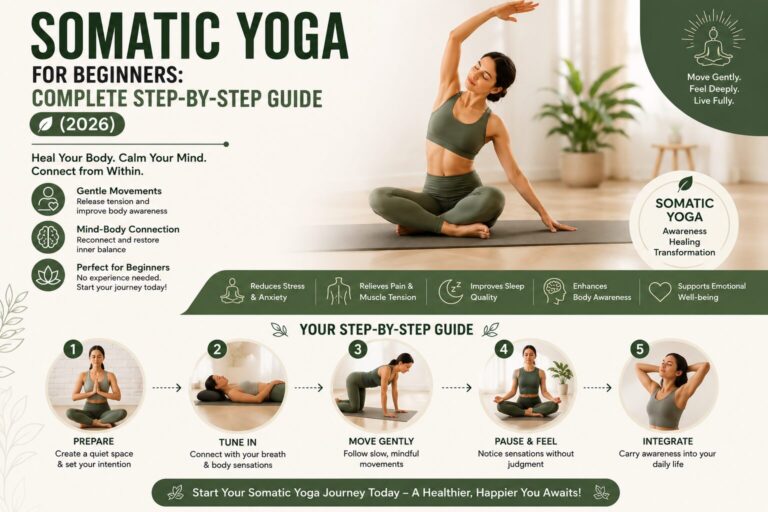
This beginner-friendly guide explains what somatic yoga is, how it may support relaxation and body awareness, and how to practice it safely at home. You’ll find simple exercises, easy cues, helpful variations, common mistakes to avoid, sample routines, safety tips, and answers to common questions. The goal is to help you start slowly, listen to your body, and build a consistent practice without pressure.

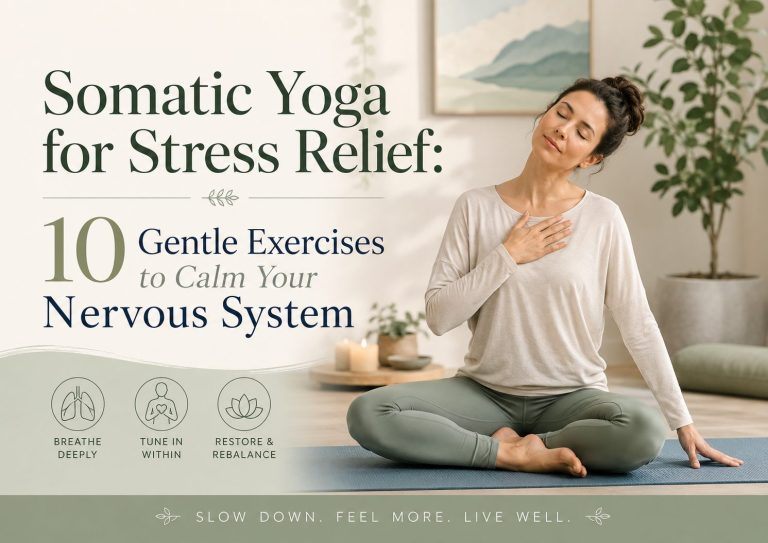
Serene yoga stretch in soft light

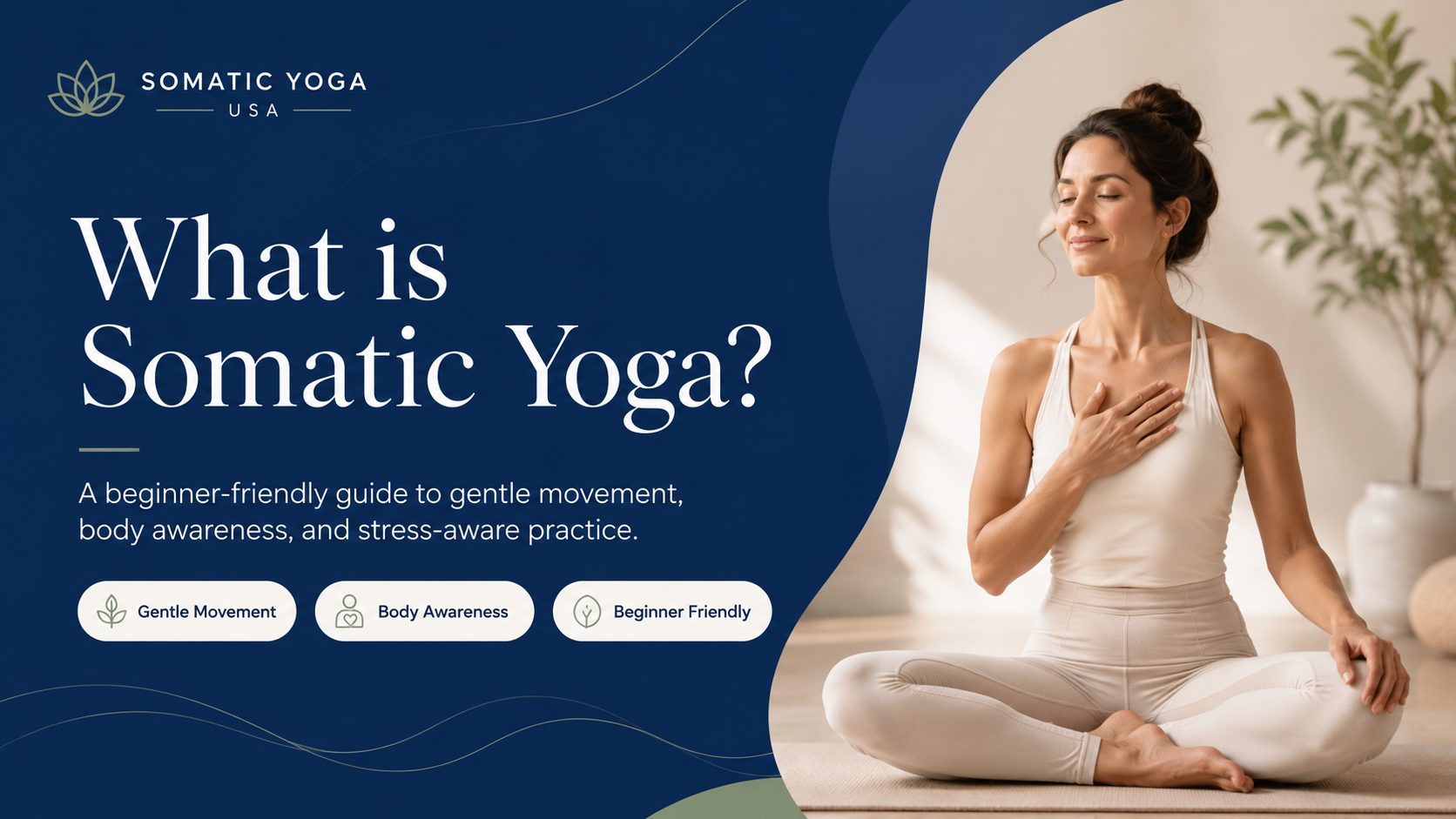
What is Somatic Yoga?

Somatic yoga is a gentle movement practice that focuses on how your body feels from the inside. Instead of pushing into difficult poses or trying to reach a perfect shape, it encourages slow movement, relaxed breathing, and body awareness.

The main idea is simple: move slowly, notice what you feel, and give your body time to release unnecessary tension. Somatic yoga may help some people feel more relaxed, improve movement awareness, and build a calmer connection with their body.

You may see terms like interoception, proprioception, and nervous system regulation in somatic yoga. In simple words, these refer to your ability to notice internal body signals, understand where your body is in space, and respond to stress with more awareness. This guide explains these ideas in an easy way so beginners can practice safely and confidently.

Why Somatic Yoga works

Somatic yoga is inspired by body-based movement and awareness practices that focus on the connection between the body, brain, breath, and nervous system. These approaches are often used to help people become more aware of tension patterns, movement habits, posture, breathing, and internal body signals.

Research on mindful movement, body awareness, and somatic-based practices suggests that they may support relaxation, mobility, stress management, and a better sense of body awareness for some people. However, somatic yoga should not be treated as a medical treatment or a replacement for professional care, especially for chronic pain, trauma, anxiety, injury, or any diagnosed health condition.

The main idea is that gentle, slow, and comfortable movement can give the body a chance to notice tension and respond without force. Over time, this may help some beginners move with more ease, feel more grounded, and build a safer, more consistent relationship with their body.

How Somatic Yoga differs from regular yoga or stretching

  • Somatic yoga is different from a fast or pose-focused yoga class. The focus is not on how the movement looks from the outside, but on what you notice inside your body while moving.

  • Movements are usually slow, small, and gentle. You may pause, breathe, scan the body, or repeat a simple motion several times to notice where tension, ease, or restriction shows up. Instead of forcing a stretch, somatic yoga encourages you to move with curiosity and stay within a comfortable range.

  • The goal is to build better body awareness, support relaxation, and help you understand your movement habits more clearly. A good somatic practice should feel calm, patient, and pressure-free. You are invited to listen to your body, adjust when needed, and stop if something feels painful or unsafe.

How to practice safely

  • Choose a quiet, comfortable space where you can move slowly without feeling rushed. A yoga mat, folded blanket, pillow, bolster, or blocks can make the practice easier and more supportive.

  • Stay within a comfortable range of movement. Mild stretching or gentle discomfort can happen, but sharp pain, dizziness, numbness, or strong discomfort is a sign to stop or adjust. Somatic yoga should feel gentle, not forced.

  • If you are pregnant, recovering from surgery, managing a serious medical condition, dealing with ongoing pain, or unsure whether movement is safe for you, speak with a qualified healthcare professional before starting.

  • Try to focus on how your body feels rather than how the movement looks. After practice, you can write down one to three simple words, such as “calmer,” “less tight,” or “more relaxed.” This helps you notice small changes over time without judging your progress.

Top 14 Somatic Yoga exercises for beginners

Below are clear actions: how long, how to do it, what to feel, variations, common mistakes, and benefit summary.

1) Full-Body Scan (5–12 minutes) — foundational

Why: Builds interoception and trains attention to internal cues.
How-to: Lie or sit comfortably. Close eyes if safe. Slowly bring attention to your feet, ankles, calves, knees, thighs, pelvis, lower back, abdomen, chest, shoulders, arms, neck, head — pausing 5–10 seconds on each region. Notice temperature, tension, breath movement, small vibrations, or emotional impressions. Breathe slowly and invite a soft, curious tone.
What to feel: Neutral noticing; try to label sensations (e.g., “warm,” “tight,” “buzzing”) without judging.
Variation: Guided voice (record yourself or use a recording). Use a body-scan script to help beginners.
Common mistakes: Trying to “fix” sensations during scan — scanning is mapping, not correcting.
Benefit: Improves body awareness and primes the nervous system for further somatic work. 

ChatGPT Image Sep 12 2025 08 59 17 PM

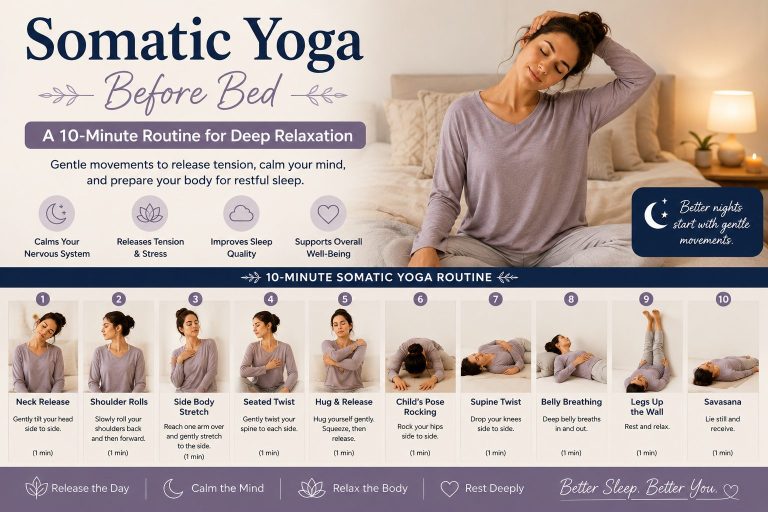
2) Gentle Breath + Diaphragmatic Bulge (3–5 minutes)

Why: Breath is the quickest lever on the autonomic nervous system.
How-to: Lie on back, knees bent. Place one hand on chest and one on belly. Breathe into the belly so the lower hand rises first; feel a gentle bulge under your lower ribs. Exhale slowly, feeling soft release. Baby Cobra Pose Guide Keep breaths 5–6 seconds in/out if comfortable.
What to feel: Belly expand and soften; relaxed jaw and shoulders.
Variations: Seated belly breathing if lying is not possible. Add a 2-second hold at the top to increase interoception.
Common mistakes: Lifting shoulders or chest as primary movement (that’s thoracic breathing — still useful but less calming).
Benefit: Calms the nervous system and increases interoceptive signal clarity.

ChatGPT Image Sep 12 2025 09 44 24 PM

3) Moving Bridge (pelvic undulations) — 5–8 minutes

Why: Releases lower back, re-patterns pelvic tone, awakens spine segmentation.
How-to: From supine, knees bent, feet hip-width. Gently rock pelvis forward/back to find movement. Then slowly articulate the spine up into a bridge—lift tailbone, lower back, mid back, then upper back—vertebra by vertebra. Pause, then articulate back down one vertebra at a time. Sync breath with movement. Move tiny ranges and notice inner sensations as you lift and lower.
What to feel: How different spinal segments light up; where breath moves.
Variations: Support sacrum on a block and explore tiny tail wagging instead of full lifts.
Common mistakes: Straining to a “high” bridge instead of mindful articulation.
Benefit: Neuroplastic retraining of low-back control; useful for chronic back stiffness. Somatic Exercises (Competitor uses this — we add micro-range options and supports)

Moving Bridge (pelvic undulations) — 5–8 minutes

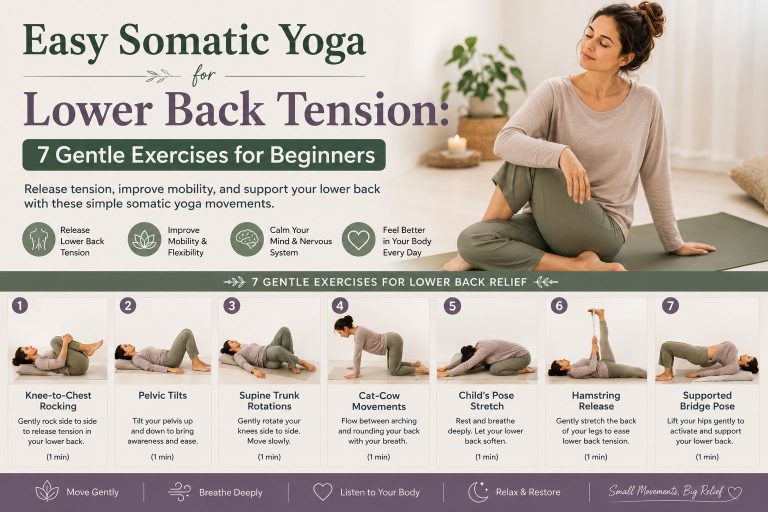
4) Knee Rock with Cactus Arms (supine, rocking + shoulder release) — 5 minutes

Why: Mobilizes lumbar spine and calms thorax via arm position (cactus arms = openness).
How-to: Supine, knees bent, feet wide. Arms in cactus (elbows bent 90°, arms out). Rock knees left-to-right with a slow breath rhythm. Optionally turn head opposite to knees for somatic cross-cueing. Notice where the spine resists or gives.
What to feel: Pelvic shifts, softening through ribcage and diaphragm.
Variation: Place a bolster under knees to reduce range.
Common mistakes: Quick, bouncy rocking — keep it slow and exploratory.
Benefit: Gentle mobilization + interoceptive feedback; can release trapped tension in ribs and shoulders.

Knee Rock with Cactus Arms (supine, rocking + shoulder release) — 5 minutes

5) Half Wind Removing / Knee pull with core awareness (supine) — 3–6 minutes each side

Why: Helps digestion, pelvic mobility, and low-tension core activation.
How-to: Supine, hug one knee into the chest. Hold mindfully — notice abdominal engagement and where breath goes. Optionally press shin into hands to create gentle resistance then relax (isometric cue), or lift head and chest slightly to intensify abdominal sensation. Then slowly release. Mirror on other side.
What to feel: Compression vs. release in hips; breath moving into belly during compression.
Variation: Keep both knees bent and do alternating pulls for easier option.
Common mistakes: Holding breath. Breathe rhythmically.
Benefit: Teaches core sensation and reduces pelvic guarding.

Half Wind Removing Knee pull with core awareness (supine) — 3–6 minutes each side

6) Seated Torso Circles (mindful spinal mobility) — 3–6 minutes

Why: Restores spinal mobility and refines pelvis-spine relationship.
How-to: Sit cross-legged or on a chair. Place hands lightly on knees. With soft focus, draw small circles with your torso, moving from tailbone > lumbar > thoracic > cervical. Keep range small and breathe into movement. Reverse direction. Pause and note difference left vs right.
What to feel: Where movement is easy vs. restricted.
Variation: Use chair for more stability or add a hand to the belly to sense core-driven motion.
Common mistakes: Using neck to lead; initiate from low ribs/pelvis.
Benefit: Re-maps spinal motion and reduces reactive guarding.

Seated Torso Circles (mindful spinal mobility) — 3–6 minutes

7) Seated Side-Body Breath & Reach — 2–4 minutes each side

Why: Releases lateral tension and improves rib mobility.
How-to: Sit tall. Place left hand on right thigh. Inhale, reach right arm up; exhale, lean gently left. Breathe into the right side ribs. Hold, then return slowly. Compare both sides.
What to feel: Increase in breath depth and space between ribs.
Variation: Use strap if reaching is limited.
Common mistakes: Collapsing the chest—keep length on inhale.
Benefit: Helps expand breath and soothes sympathetic arousal.

Seated Side Body Breath & Reach — 2–4 minutes each side

8) Sphinx + Half-Frog (prone openings) — 4–6 minutes

Why: Gentle anterior chain opening; interoceptive access to front body.
How-to: Lie prone. Slide elbows under shoulders and lift into Sphinx. Breathe into the belly and front ribs. Optionally bend one knee, opening the hip (half-frog) slowly while breathing into the hip and lower belly. Explore gentle rocking if that feels safe.
What to feel: Softening in chest, activation patterns in back muscles.
Variation: Props under hips if lower back sensitive.
Common mistakes: Overarching quickly; instead, micro-move and observe.
Benefit: Opens fronts of body and enhances nervous-system tone regulation.

Sphinx + Half Frog (prone openings) — 4–6 minutes

9) Extended Child’s Pose + Pandiculation (rest + spontaneous stretch) — 3–6 minutes

Why: Pandiculation is a nervous-system-led stretching pattern that helps reset tone. Research highlights pandiculation’s role in maintaining myofascial health and transitions between states. PubMed
How-to: From all-fours, walk knees wider, big toes touch. Fold to Child’s Pose. Breathe into spine, then invite a slow animal-like stretch: spread fingers, reach arms forward, gently arch and lengthen like a cat yawning, then return to rest. Notice what changes in muscle tone. Repeat slowly.
What to feel: Waves of lengthening and softening as muscles “unlearn” constant tension.
Common mistakes: Forcing a big stretch — pandiculation is slow and voluntary but gentle.
Benefit: Resets chronic muscle tone and increases sense of safety in movement.

Extended Child’s Pose + Pandiculation (rest + spontaneous stretch) — 3–6 minutes

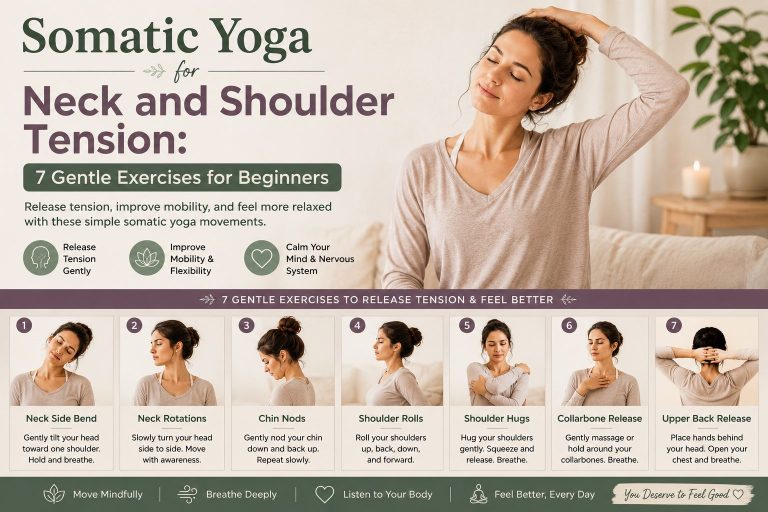
10) Gentle Neck Circles (seated) — 2–3 minutes

How-to: Sit upright. Imagine a pencil at the crown drawing small circles on the ceiling. Keep jaw soft, eyes relaxed. Start small, then slightly larger. Reverse. Always move slowly.
What to feel: Subtle shifts in trapezius and jaw; breath into upper chest.
Variation: Perform with chin tucked slightly for a safer range if you have neck issues.
Common mistakes: Rolling too large/fast or compressing the back of the neck; maintain length.
Benefit: Helps downregulate shoulder tension and jaw clenching.

Neck Circles

11) Pelvic Clock (supine micro-tilts) — 3–5 minutes

Why: Refines pelvic proprioception and low-back control.
How-to: Lie supine, knees bent. Imagine your pelvis as a clock. Slowly tilt toward 12 (anterior), 6 (posterior), 3 (right), 9 (left) — or make a small circular sweep. Keep movements tiny and breathe into the area you move. Observe which “time” feels sticky.
What to feel: Minute shifts in low-back and glute activation.
Variation: Use feet wider to change pelvic feedback.
Common mistakes: Large levered movements; this is about subtle neural retraining.
Benefit: Great for low-back pain related to poor pelvic control.

Pelvic Clock (supine micro tilts) — 3–5 minutes

12) Clamshell with sensory focus (side-lying) — 4–6 minutes each side

Why: Improves hip control while training internal sensation (psoas/glute ratio).
How-to: Lie on side with knees bent and stacked. Open the top knee slowly (like a clamshell), noticing where you feel movement: hip socket, lateral glute, or outer thigh. Optionally add a gentle isometric press (press knee into hand) then relax to increase feedback. Keep motion small.
What to feel: Where you actually move and which muscles light up.
Common mistakes: Using momentum or rotating pelvis; keep pelvis stacked and still.
Benefit: Effective for hip stability and for releasing emotional holding in psoas region. (Competitor mentions hips — this expands with sensory cues.)

Clamshell with sensory focus (side lying) — 4–6 minutes each side

13) Mindful Walking (5–10 minutes)

Why: Applies somatic awareness to functional movement, integrating posture, breath, and rhythm.
How-to: Walk slowly in a quiet space. Notice heel strike, weight shift, how pelvis rotates, breath depth, and any habitual patterns (e.g., stiff hip, heavy heel strike). Keep attention local — pick one feature each round.
What to feel: Whole-body integration of sensory and motor maps.
Variation: Walk 1–2 minutes eyes closed if safe, to heighten proprioceptive feedback.
Common mistakes: Speeding up; the practice is slow and investigative.
Benefit: Transfers on-the-mat learning to everyday movement.

Mindful Walking (5–10 minutes)

14) Self-Hug + Grounding Sway (1–3 minutes)

Why: Somatic self-contact is soothing and practical when anxiety spikes.
How-to: Sit or stand. Wrap arms around yourself, breathe into the front body. Optionally sway gently side-to-side. Notice temperature of hands, softening in shoulder blades, and breath depth.
What to feel: Immediate calming, sense of containment.
Common mistakes: Gripping too hard — keep it loving and soft.
Benefit: Fast nervous-system down-regulator; useful at work or in public places.

Self Hug + Grounding Sway (1–3 minutes)

Putting the exercises into practice — sample routines

Below are ready-to-use micro-workouts. Choose one based on available time.

20-minute “Reset” (daily)

  1. Full-Body Scan (4 min)

  2. Breath + Diaphragmatic Bulge (3 min)

  3. Pelvic Clock (3 min)

  4. Clamshells (2 min each side)

  5. Self-hug + Grounding Sway (2 min)
    Finish by noting one change in sensation.

30-minute “Calm & Open” (3x/week)

  1. Full-Body Scan (5 min)

  2. Moving Bridge (6 min)

  3. Seated Torso Circles + Side Body ~ (6 min)

  4. Sphinx + Half-Frog (5 min)

  5. Extended Child’s Pose + Pandiculation (4–6 min)

45-minute “Deep Reset” (1–2x/week)

  • Full-Body Scan (7 min)

  • Breath practice + Diaphragmatic Bulge (5 min)

  • Moving Bridge (8 min)

  • Knee Rock + Cactus Arms (5 min)

  • Pelvic Clock + Clamshells (8 min)

  • Mindful Walk (5 min)

  • Savasana or Long Rest (5–10 min)

6-Week Starter Progression (goal: retrain comfortable ranges and nervous system)

  • Week 1 (habits): 10–20 minutes daily — full-body scan, breath work, pelvic clock. Note sensations before & after.

  • Week 2 (consistency): Add 1 mobilizing exercise (moving bridge or knee rock) every other day. Continue daily scan.

  • Week 3 (integration): Include mindful walks twice a week; practice clamshells/hip micro-work.

  • Week 4 (expansion): Increase hold times; add pandiculation in child’s pose. Track pain levels and sleep.

  • Week 5 (functional): Do a 30-minute practice 3x/week. Bring somatic cues into daily tasks (standing desk shifts).

  • Week 6 (assess): Compare journal notes — tension, sleep, reactivity. Create a maintenance plan: 3–5 short sessions per week + mindful walk daily.

Measuring progress (simple metrics to track)

  • Pain scale (0–10) before & after practice each week.

  • One-sentence notes: “what changed” (“less tight in lower back,” “calmer heart”).

  • Objective markers: minutes to fall asleep, # of pain-free days/week, ability to bend forward/back without guarding.

Props, environment & micro-habits

  • Props: Blanket or folded towel, bolster, eye pillow, small block — use these to reduce stretch intensity so you can feel micro-movements.

  • Lighting/music: Low light + quiet or gentle ambient music helps interoception.

  • Micro-habits: 30-second breath check before meetings, 2-minute self-hug after phone calls, mindful walking to the kettle.

Safety, contraindications & when to see a professional

  • If you have structural spinal instability, uncontrolled hypertension, or are recovering from major surgery, consult a clinician before beginning.

  • For complex trauma: somatic practices can surface emotions. Consider working with a trauma-informed somatic therapist if intense memories or panic arise. Research suggests somatic approaches can help PTSD symptoms but are best integrated with mental-health support for some people. PMC

  • If an exercise produces sharp, shooting pain, stop. If pain persists, see a physiotherapist or physician.

Evidence & references (short reading list)

  • Principles connecting somatic practices and pain management: Moving With Pain (review). PMC

  • Randomized trials on somatic approaches for trauma/chronic pain: Somatic Experiencing RCTs. PMC

  • Interoception and contemplative practice: Frontiers / PMC review (interoception → emotion regulation). PMC

  • Pandiculation research and myofascial integrity. PubMed

  • Somatic movement intervention improving mobility in older adults. ScienceDirect

(For background on common Somatic Yoga exercises and an approachable beginner list, see the competitor article we analyzed; this guide expands that list and adds routines, progression plans, and evidence summaries.)

Also Read: Yoga Exercises for Anxiety Guide – simple poses to calm your mind & body.

Final Thought

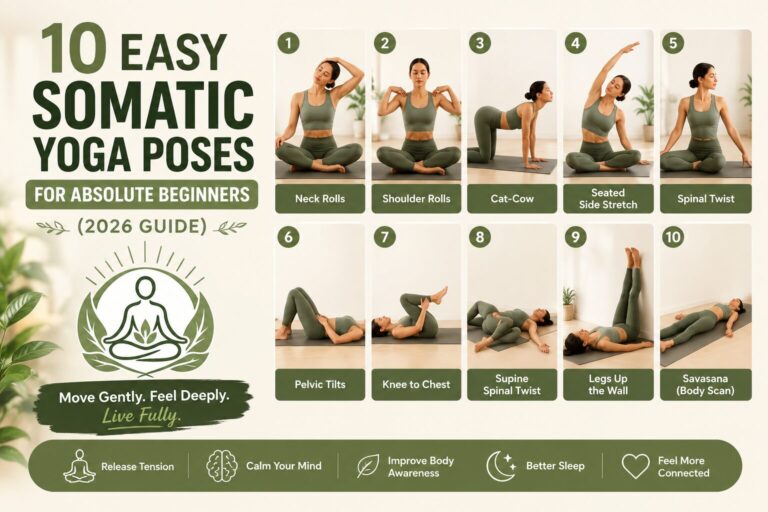
Your body is not just a machine; it’s a living, sensing, intelligent system that responds to every breath, thought, and movement you make. By practicing these 10 somatic yoga exercises, you’re not only stretching muscles — you’re retraining your nervous system, unlocking stored tension, and reawakening your body’s natural rhythm.

Somatic yoga works because it speaks the language your body understands: slow, mindful, and intentional movement. This activates the brain’s sensory-motor pathways, helping you release patterns of pain, stiffness, and fatigue that traditional workouts often overlook.

Remember — consistency beats intensity. Even 10–15 minutes a day can transform how you feel, move, and think. Start small, listen to your body, and let the changes unfold naturally. Over time, you’ll notice not just more flexibility and strength, but also a deeper sense of calm, confidence, and connection with yourself.

Your body already knows how to heal — somatic yoga simply shows it the way.

Frequently Asked Questions

What is somatic yoga?

Somatic yoga is a gentle movement practice that focuses on body awareness, slow movement, and relaxed breathing. Instead of forcing the body into difficult poses, it encourages you to notice how your body feels and move within a comfortable range.

Is somatic yoga good for beginners?

Yes, somatic yoga can be beginner-friendly because the movements are usually slow, simple, and easy to adjust. Beginners should start with short sessions, move gently, and stop if anything feels painful or uncomfortable.

How often should I practice somatic yoga?

Many beginners start with 10 to 20 minutes a few times per week. The best routine is one you can follow consistently without pressure. Short, regular practice is often more helpful than forcing long sessions.

Can somatic yoga help with stress?

Somatic yoga may support relaxation and stress management for some people by combining gentle movement, breathing, and body awareness. It should not be used as a replacement for professional mental health or medical care.

Is somatic yoga the same as regular yoga?

No. Traditional yoga often focuses on poses, flexibility, strength, or flow. Somatic yoga focuses more on internal sensation, slow movement, and noticing how the body responds from the inside.

Who should be careful with somatic yoga?

If you are pregnant, recovering from surgery, dealing with ongoing pain, managing a serious medical condition, or unsure whether movement is safe for you, speak with a qualified healthcare professional before starting.

Quick checklist (before you practice)

  • Quiet, safe space + a mat/blanket.

  • Timer set (if you want a measured session).

  • Journal or quick notes for post-practice reflections.

  • Remind yourself: Curiosity > Doing. Practice is about noticing.

Conclusion — start gentle, stay curious

Somatic Yoga gives you practical, science-aligned tools to shift how your nervous system holds tension — not by forcing more flexibility, but by teaching your brain new, safer movement patterns. Start simple: a 10–20 minute daily routine of breath, a brief scan, and one micro-movement (pelvic clock or moving bridge). Track one small change a week; that’s how deep, lasting shifts happen.

Scroll to Top